

Major repair projects can place significant pressure on an HOA or condominium association board. What may begin as a known maintenance issue can quickly become a complex construction project involving structural concerns, contractor pricing, schedules, resident communication, safety considerations, and long-term financial decisions. For many boards, the challenge is not simply deciding that repairs are needed. The larger challenge is knowing how to move from concern, to evaluation, to design, to contractor pricing, and finally to completed work.
This is where a qualified project manager can provide significant value.
For homeowners associations and condominium owners associations, major repair projects often involve common elements that affect multiple owners. These may include parking garages, structural columns, concrete slabs, retaining walls, foundations, decks, balconies, drainage systems, septic systems, and other shared property components. When these items fail or begin to deteriorate, the repair process can involve engineering judgment, contractor coordination, permitting questions, access issues, budget decisions, and potential disruption to residents.
An HOA board may be capable of handling normal association decisions, but managing a construction repair project is different. Construction management requires technical knowledge, organized communication, schedule tracking, contractor coordination, and the ability to recognize when the work being performed does or does not match the intended repair approach. Industry discussions on construction management commonly emphasize the value of having an owner’s representative who can help with planning, budgeting, communication, quality control, and oversight throughout the project.
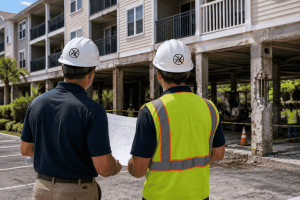
Major Repairs Need More Than a Contractor
Hiring a contractor is an important step, but it is not the same as having a project manager. A contractor is typically responsible for performing the work described in the contract. The contractor’s focus is construction execution. The HOA, however, still needs someone representing the association’s interests, reviewing the scope, helping compare quotes, monitoring progress, and identifying issues before they become larger problems.
For complex repairs, especially structural repairs, the board may also need engineering input before contractor pricing can be meaningfully compared. If three contractors are asked to price a repair without a clear engineered scope, the board may receive three very different proposals. One contractor may include extensive repair work, another may include a limited patch, and a third may exclude important items entirely. This makes it difficult for the board to compare pricing, understand risk, or make a confident decision.
A project manager with engineering experience can help bridge this gap. The process can begin with an evaluation of the property, followed by a repair design or written scope of work. Contractor quotes can then be requested based on clearer expectations. This helps the board compare proposals more fairly and reduces the likelihood of misunderstandings after construction begins.
The Value of Engineer-Led Project Management
Southeast Engineering & Development Group, LLC, also known as SE EDG, provides a valuable combination of engineering and project management support for HOA and COA repair projects. SE EDG’s team includes Professional Engineers with extensive experience in construction, design, inspection, quality assurance, and project management. The firm provides services such as Property Condition Assessments, Capital Needs Assessments, Reserve and Transition Studies, structural assessments, engineering consulting, repair design, contractor quote support, and construction-phase project management.
This combination matters because many HOA repair projects are not purely administrative. They require technical decisions. For example, structural column replacements, concrete repairs, helical pier installations, drainage-related repairs, retaining wall work, septic tank replacements, and foundation repairs may all require an understanding of load paths, soil conditions, existing construction, material deterioration, constructability, and long-term performance.
An engineer-led project manager can help the board understand what is happening, why it matters, and what steps should be taken next. This does not mean the project manager replaces the contractor. Instead, the project manager helps the association define the problem, organize the repair process, review contractor input, and monitor the project on behalf of the HOA or COA.
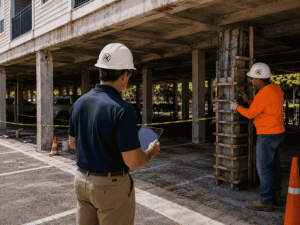
Oversight During the Work
Even with a good design and a qualified contractor, construction projects still require oversight. Existing conditions may differ from what was visible during the initial evaluation. Hidden deterioration may be uncovered. Weather, access limitations, resident coordination, or material availability may affect the schedule. Field questions may arise.
A project manager can serve as the board’s representative during the work. This may include attending site meetings, reviewing progress, observing key repair activities, answering technical questions, helping evaluate change order requests, and providing updates to the board. For structural repairs, having an engineer involved during construction can be especially helpful when field conditions require judgment.
This oversight can also improve communication. Board members and property managers often have many responsibilities. They may not have time to track construction details, respond to technical questions, review contractor requests, and communicate with residents. A project manager helps organize those moving parts so the board can remain informed without having to manage every detail directly.
When Should an HOA Consider a Project Manager?
An HOA or COA should strongly consider a project manager when the project involves structural repairs, multiple contractors, significant cost, resident disruption, safety concerns, unclear scope, or technical questions. This is especially true for repairs involving columns, foundations, concrete deterioration, helical piers, retaining walls, parking structures, drainage problems, or other critical property components.
A project manager helps the board move from uncertainty to action. For complex repair projects, that leadership can make the difference between a stressful, reactive process and a more organized, professional, and defensible outcome.
For associations facing major repairs, SE EDG can serve as more than a structural engineering consultant. We can be your technical advocate, repair designer, contractor quote reviewer, and project management partner from evaluation through completion. Call us at (678) 737-3070.